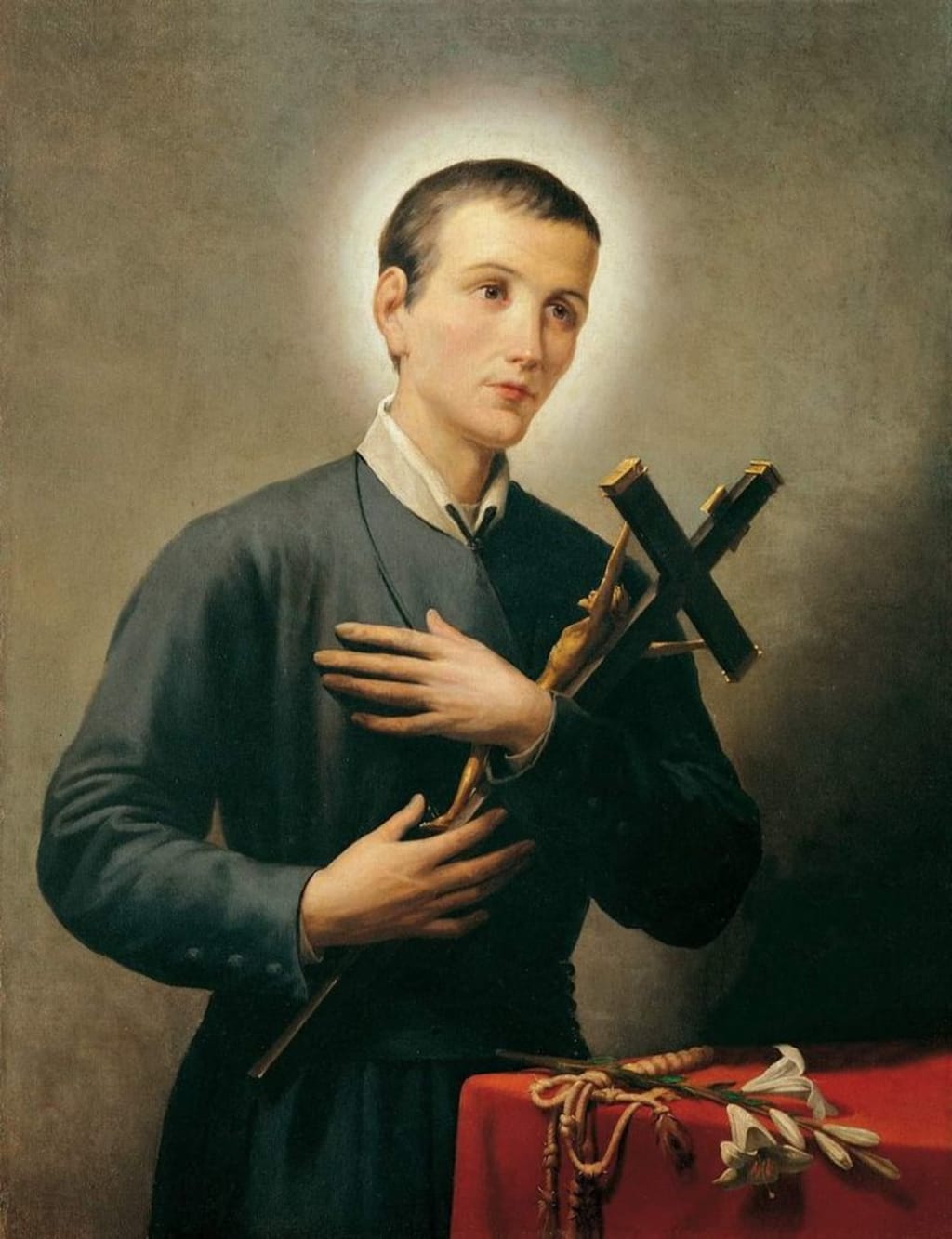
Gerard Majella came to be invoked particularly as patron saint of pregnant women, for reasons hard to discern. He was only a humble Redemptorist lay brother. Yet he did have a strong spiritual influence on women as well as men, something unusual for one who was not a priest. Gerard was born at Muro Lucano in southern Italy. He grew up a very pious child. Perhaps because of his goodness he was often ill-treated by the fellow craftsmen with whom he studied tailoring, and even by the choleric Bishop of Lacedogna, in whose service he spent some time. Actually, Majella aspired to join a religious order, but when the Capuchins rejected him as too young and of too uncertain health, he returned to his fatherless family and set up on his own as a tailor. Meanwhile, he devoted an increasing amount of time to prayer and self-denial. He earned enough, but two thirds of his earnings went to the poor or to Masses for the souls in purgatory.
Around 1749, when he was 23, the young tailor was deeply impressed by a mission preached by priests of a new religious order, the Redemptorists. He asked that community if he might join them as a lay brother. The Redemptorists, too, hesitated because of his poor health, but finally they accepted him. The founder of the Redemptorists, St. Alphonsus de Liguori, was impressed by the young man, and shortened the required novitiate. Gerard made his profession as a lay brother in 1752, adding to the three usual vows one that bound him always to do what seemed most pleasing to God. His career as a lay brother was brief but brisk. For the first three years his chief tasks were tailoring and working in the infirmary. But he also became noted for the spiritual contacts that he made while he accompanied the missionary fathers on their rounds. It seems that he had unusual charismatic abilities. Thus he could read the hearts of people, and brought a score of them back to God through this insight. He had the gift of prophecy. He had the gift of levitation as well: he could be lifted into the air in the midst of ecstatic prayer. Most extraordinary of these gifts, however, were his “bilocations”. He could be, or seem to be, in two places at the same time. Not only did the Redemptorist superiors recognize Brother Gerard’s singular gifts, they even named him spiritual director to several communities of nuns - an appointment seldom given to a non-priest. He also carried on correspondence with priests and religious superiors, giving them sound advice. Furthermore, he won a reputation for working miracles. When the crowds seeking cures became too great at one house where he was stationed, he had to be transferred to another house. There he was appointed to tend the door, but soon he was feeding and clothing countless beggars. Nobody knew where the food and clothing came from, except him.
We have mentioned Brother Gerard’s illness that had twice deferred his admission to a religious order. It was tuberculosis, and it overtook him after only three years as a Redemptorist. He announced that he would die on the night of October 15-16, 1755, and he did precisely that. Pope Pius IX would call him “a perfect model for lay brothers.” In 1904 Pope St. Pius X canonized this “most famous wonderworker of the 18th century.” It was shortly after his death that St. Gerard became the popular patron of the pregnant. A story is told that suggests why this patronage may have developed. On one occasion a young woman named Neria Caggiano, whom Gerard had befriended but who was of wanton disposition, accused him of immoral behavior. St. Alphonsus, incredulous, summoned Brother Gerard to Nocera for questioning. In keeping with his vow to do the more perfect thing, the Brother neither affirmed nor denied the charge. St. Alphonsus, therefore, punished him by forbidding him to receive Holy Communion and to have further dealings with outsiders. This situation went on for several weeks. Then Neria confessed that she and her accomplice had lied in preferring the charge.
“Why didn’t you protest your innocence?” Liguori then asked Brother Gerard. "Father, Gerard replied, “doesn’t our rule forbid us to excuse ourselves?” --Father Robert F McNamara
Scripture: Philippians 3: 8-14
I regard everything as loss because of the surpassing value of knowing Christ Jesus my Lord. For his sake I have suffered the loss of all things, and 1 regard them as rubbish, in order that I may gain Christ and be found in him, not having a righteousness of my own that comes from the law, but one that comes through faith in Christ, the righteousness from God based on faith. I want to know Christ and the power of his resurrection and the sharing of his sufferings by becoming like him in his death, if somehow I may attain the resurrection from the dead. Not that I have already obtained this or have already reached the goal; but I press on to make it my own, because Christ Jesus has made me his own. Beloved, I do not consider that 1 have made it my own; but this one thing I do: forgetting what lies behind and straining forward to what lies ahead, I press on toward the goal for the prize of the heavenly call of God in Christ Jesus.
Writings (Year A)
My Lord Jesus Christ, behold me in Thy sight, ready to write down, and to promise Thy Divine Majesty that I will faithfully observe these my resolutions. It is long since I first made them. Now with the permission I have received, I confirm them all. Grant, Lord, that I may be found faithful. Woe is me! I cannot trust in myself, unable as I am of myself to perform the smallest undertaking. But I trust solely in Thee, Who art Infinite Goodness and Mercy, and Who canst never but prove faithful to Thy Promises, O Thou supreme Goodness! Whenever I have failed, the failure came from myself alone. Henceforth I will that Thou shouldst act in me. Grant, I beg of Thee, that I may observe all exactly and without fail - of Thee do I confidently hope to obtain this grace, O Thou inexhaustible Treasure of Mercy.
I choose the Holy Spirit to be my only comforter and protector in all things. May He be my defence, and root out all my faults.
I. O my God and my only Love, today and every day I give myself up to Thy Good Pleasure. In all temptations and trials, I will say always "Thy will be done." All that Thou mayest ordain for me I will embrace with my whole heart, never ceasing to raise my eyes to Heaven, there to adore the Divine Hands which cast towards me the precious pearls of Thy Most Holy Will. II. Lord Jesus, I wish to carry out all that is commanded me by my Mother the Holy Catholic Church. V. I will only speak in three cases: when the glory of God is at stake; when the interests of my neighbour may demand it; or when it is necessary for some personal reason. VII. Instead of any words that I might be tempted to speak to the displeasure of God, I will say: "My Jesus, I love Thee with my whole heart." VIII. I will say nothing either good or bad about myself. I will act as if there were no such person as I in existence. IX. I will never excuse myself whatever reason I may have for doing so, unless any sin against God would result from my silence, or any harm to my fellowman. XII. I will attack no one in conversation, nor will I make any reference to the faults of my neighbours, even by way of a joke. XIII. I will be careful to excuse everyone, considering in my neighbour the Person of Jesus Christ Himself, Whom the Jews accused, notwithstanding His innocence. I will defend others, especially in their absence. XIV. If anyone should speak ill of another, I will warn him of his fault, even though he be the Father General. XV. I will do my utmost to manage that others should be spared any occasion of annoyance. XVI. If I should notice anyone committing a fault, I will be careful not to correct him in the presence of others. I will speak to him on the matter between ourselves, and in a low tone of voice. XIX. Never will I mix myself up with anyone else's business. I will never say that anyone has done anything badly. XX. Whenever I am told to help others in their work, I will obey the responsible person exactly and without remark. I will never allow myself to say that anything is not done as it should be. Still, when I know from experience how things should be carried out, I will give my advice, but never in the tone of a master. XXI. When I am joined with others in discharging the duties of the house, however trivial they may be (Sweeping the corridors, moving furniture, and the like), I will make it my rule never to be anxious to get the best place or the best things. Conveniences I will yield to others, taking for myself what God may leave me. Thus everyone will be pleased, myself among the rest. XXV. In all my interior conflicts, I will be careful not to listen to self-love. If anyone blames or accuses me, I will strive to make all bitter feelings pass gently away. Then tranquillity will reign at the bottom of my soul. XXVI. My supreme resolution is to give myself unreservedly to God. For this reason I will endeavour to have continually before my eyes this motto: "Be thou deaf, blind, and mute." XXVII. I will not know the meaning of the words "I will" or "I will not." Only one thing do I desire - Thy good pleasure, O my God, and not mine own. In me, O Lord, may Thy Will, not mine, be done. XXVIII. To do the Will of God it is necessary that I should give up mine own. I wish to possess God only; if, then, | wish for God alone, it must needs be that I should detach myself from all that is not God. XXXI. May all my prayers, Communions, and all my good works be always applied for the salvation of poor sinners in union with the Precious Blood of Jesus Christ. XXXII. If anyone is wanting in the patience necessary for him to endure the trials that God sends him, and ask me to help him, I will pray for his intention, and for three days offer up all that I do in order to obtain for him a perfect conformity with the Divine Will. XXXVI. In visiting the Blessed Sacrament, I will make the following Acts: "O Lord Jesus, I believe that Thou art present in the Blessed Sacrament, and I adore Thee with all my heart." I have the intention of adoring Thee by this visit wherever Thou art present in the Sacred Host, and I offer Thee Thy Precious Blood for poor sinners. Also I desire to receive Thee Spiritually as many times as there are sanctuaries on earth in which Thou dost dwell." XXXVII. I will make these Acts of the Love of God. "O my God, I have the intention of offering Thee as many acts of love as have been ever made Thee by the Most Holy Virgin and all the Saints in Heaven, as well as by all the Faithful on earth. I would love Thee as much as Jesus Christ loves Thee, and as He loved His chosen ones. I would renew these acts with every beating of my heart. I offer these my desires to my Mother Mary." (Resolutions)
Musical Selection
Collect
O God,
you willed to draw Saint Gerard to yourself from his earliest years
and to mold him to the image of your crucified Son.
Grant, we pray,
that following the example of his life,
we may be transformed in the same image.
We ask this through our Lord Jesus Christ, your Son,
who lives and reigns with you and the Holy Spirit,