Introit
Collect
May your grace, O Lord, we pray,
at all times go before us and follow after
and make us always determined
to carry out good works.
Through our Lord Jesus Christ, your Son,
who lives and reigns with you in the unity of the Holy Spirit,
God, for ever and ever. Amen.
First Reading Is 25:6-10a
On this mountain the Lord of hosts will make for all peoples a feast of rich food, a feast of well-aged wines, of rich food filled with marrow, of well-aged wines strained clear. 7 And he will destroy on this mountain the shroud that is cast over all peoples, the sheet that is spread over all nations; he will swallow up death forever. 8 Then the Lord God will wipe away the tears from all faces, and the disgrace of his people he will take away from all the earth, for the Lord has spoken. 9 It will be said on that day, Lo, this is our God; we have waited for him, so that he might save us. This is the Lord for whom we have waited; let us be glad and rejoice in his salvation. 10 For the hand of the Lord will rest on this mountain.
Responsorial Psalm
R/. I shall live in the house of the Lord all the days of my life.
Second Reading Phil 4:12-14,19-20 2
I rejoice in the Lord greatly that now at last you have revived your concern for me; indeed, you were concerned for me, but had no opportunity to show it. 11 Not that I am referring to being in need; for I have learned to be content with whatever I have. 12 I know what it is to have little, and I know what it is to have plenty. In any and all circumstances I have learned the secret of being well-fed and of going hungry, of having plenty and of being in need. 13 I can do all things through him who strengthens me. 14 In any case, it was kind of you to share my distress. 19 My God will fully satisfy every need of yours according to his riches in glory in Christ Jesus. 20 To our God and Father be glory forever and ever. Amen.
Alleluia Cf. Eph 1:17-18
Gospel Mt 22:1-14
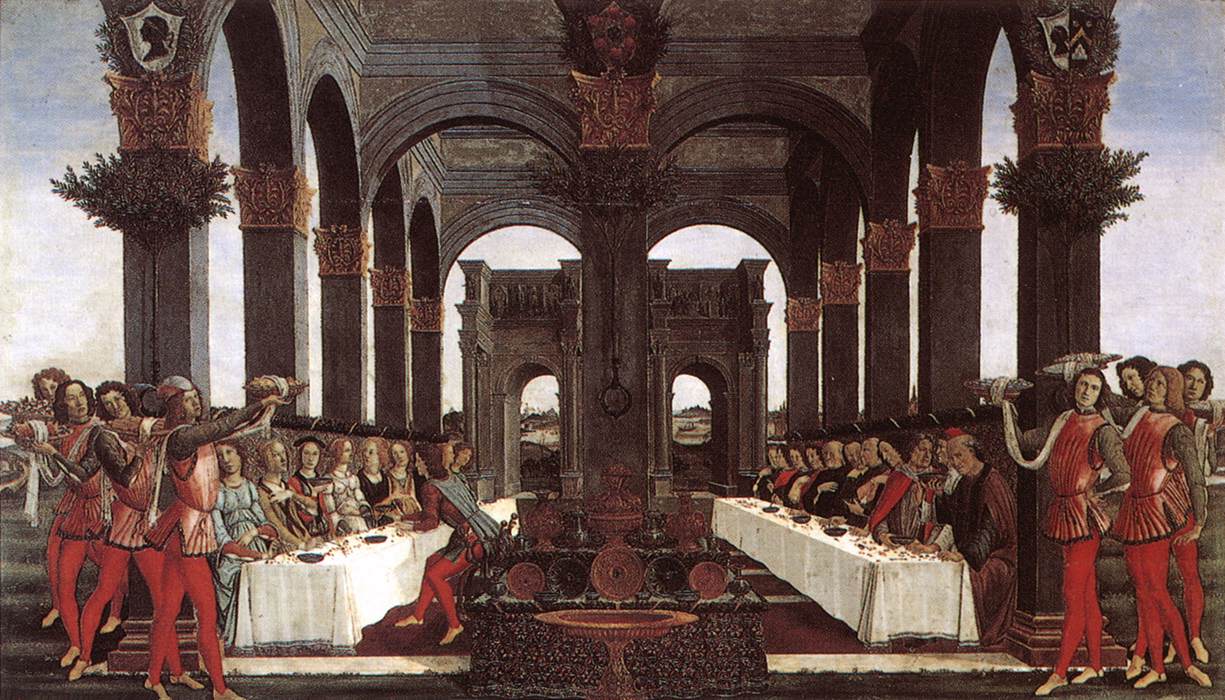
Once more Jesus spoke to the chief priests and Pharisees in parables: 2 “The kingdom of heaven may be compared to a king who gave a wedding banquet for his son. 3 He sent his slaves to call those who had been invited to the wedding banquet, but they would not come. 4 Again he sent other slaves, saying, ‘Tell those who have been invited: “Look, I have prepared my dinner, my oxen and my fat calves have been slaughtered, and everything is ready; come to the wedding banquet.”’ 5 But they made light of it and went away, one to his farm, another to his business, 6 while the rest seized his slaves, mistreated them, and killed them. 7 The king was enraged. He sent his troops, destroyed those murderers, and burned their city. 8 “Then he said to his slaves, ‘The wedding is ready, but those invited were not worthy. 9 Go therefore into the main streets, and invite everyone you find to the wedding banquet.’ 10 Those slaves went out into the streets and gathered all whom they found, both good and bad; so the wedding hall was filled with guests.
Catena Nova
What then are we to understand by the wedding garment, if not charity? For whoever in the Church possesses faith, but has not charity, comes in to the wedding, but does not come in with a wedding garment. Rightly is charity called a wedding garment; for our Creator wore this upon Him when He came to the marriage of Himself with the Church. It was solely through the charity of God that His Only-Begotten joined to Himself the souls of the chosen among men. It was because of this that John says: For God so loved the world, as to give his only begotten son for us (Jn. 3:16). He therefore Who came to us because of charity, has made known to us that charity is the wedding garment. And each one of you who through believing is now within the Church, has already come to the wedding. But they come without a wedding garment who do not safeguard within them the grace of charity. (Pope St. Gregory the Great).
O Jesus, Sun of Justice, come, let me clothe myself in Thee, (cf. Rom. 13:14) that I may live as Thou wouldst have me live. Let me so follow Thee that I may keep the garment of my baptismal innocence white, holy, and unspotted, and bring it unimpaired before Thy judgment seat, to keep it unto eternal life. Amen. Come, O Love, let Thy perfect love for me be my end and my perfection. When evening falleth, show me the covenant of spiritual marriage which my heart now entereth upon with Thee. In the countenance of my God, whom I love surpassingly, Thou art the Light of the evening star. O my beloved and glorious Evening, graciously appear unto me at the hour of my death, that I may have in Thee the long-desired evening of my sojourn upon earth, and gently fall asleep and take my repose in the blessed haven of Thy breast. O Love, O God, Thou who art my deliverance, graciously infold my soul within Thee; then, arrayed in Thee and in Thy regal beauty, I shall appear worthily in the presence of my eternal Bridegroom, clad in my wedding garment and bearing my bridal dowry (St. Gertrude of Helfta).
It is the peace-loving and meek King, Christ Jesus, who brings us into that banquet hall to accomplish in us wonderful and surprising things. He assumes the title of king to signify the magnificence of his gifts, the extent of his infinite power and, at the same time, wishes to show us his most tender love by which he leads us into this asylum of peace. He will make us rich in merit and virtue, it we only respond to his graces. He uses the image of a banquet hall to remind us of the conduct that we should observe so that we might receive and cherish his heavenly favors by means of a most intimate recollection in prayer. So, ultimately, let us be guided in our approach in order that in his banquet hall the most loving Lord may serve us with substantial food and drink. His nourishment will renew our hearts and fortify our souls unto salutary works for life eternal....Since the King of Glory has brought us into this banquet hall, let us establish here our own peaceful abode in time. Also, let us reenforce the foundations of the holy city of God with the bonds of charity. Let us remember that the nuptial bed of the peace-loving King is the Cross, and, that our souls upon this nuptial bed yearn for the most tender embraces of affection toward Jesus. He has redeemed us through love, has shed all his Blood in love, and through him we have a mystical dwelling in his heart (St. Gaspar del Bufalo).
Let us remember that this business of not ‘wearing a wedding garment’ cannot be read as a reference to someone’s moral behavior, for Matthew has emphasized that all were called in, good and bad alike. Besides, it is known that the custom of that age and place was to provide tunics to place over one’s street clothes so as to participate in a wedding party, and which would have been at the disposal of all the guests on their way in, without the slightest consideration for how good or bad they were. Here there is something of what we had in the previous parable [of the wicked tenants]. The problem with the silent guest is that he does not imagine himself to be at a wedding banquet, but in a place of judgement, and for this reason does not dare to speak when he is addressed, and so receives treatment according to his imagination (James Alison).
Homily
Intercessions
For peace in our own cities and communities: that God will help us to understand the pain of those who have suffered injustice and give us the courage to work for reconciliation.
For all who are ill: that God will ease their suffering, return them to health, and that they may experience God’s abiding presence with them.
For Wisdom: that God will help us hear and discern the truth during this year's political campaigns, and help us to respect each person as we recognize their strengths and weaknesses.
God of goodness and kindness, you invite all peoples to the banquet and offer them a feast beyond compare. Give us your saving grace to keep unstained the robe of our baptism until that day when you welcome us to heaven’s joyful table. We ask this through Christ our Lord. Amen.
Offertory Antiphon
Offertory Hymn
God’s own reign can be envisioned
As a royal wedding feast
Unto which the king invited
Both the greatest and the least.
Those invited spurned his goodness,
So the call was then sent out:
Go into the roads and shout:
“All is ready for the banquet!
Bring within the good and the bad—
There are seats still to be had!”
In the days which soon will be coming,
God will on the mount provide
Lavish food and finest vintage,
Wiping tears from ev’ry eye.
Death itself will be vanquished.
And our God will then erase
All that keeps us from grace;
On the mountain God established
We shall dwell eternally,
There restored, renewed, set free.
In our hardships, we are strengthened
By the love of Jesus still.
God shall, all our needs perceiving,
Richly give in gracious will.
Thus invited to the banquet,
Where the feast shall ever last,
We by God shall be kept fast.
Let us live in light of mercy
That our wedding garment bright
Find full favor in God’s sight.
Communion Antiphon
Closing Hymn (John Michael Talbot)
Let us kiss with the touch of our life
Call me, Lord, to your chambers
For your kiss is an excellent wine
Flowing smoothly, poured out for a lover.
For the bride belongs to the lover
And the bridegroom yearns for his bride
So come to the night, there to empty our life
To be fulfilled with the flowers of dawn.
Let us go to the vineyard, my love
To see if the vines are in bloom
If the vines have opened to blossom new life
So I will open to you
As the flowers send forth their fragrant perfume
So the doors of my love shall be open
For I have stored up my treasure for you
And now I give you my love.