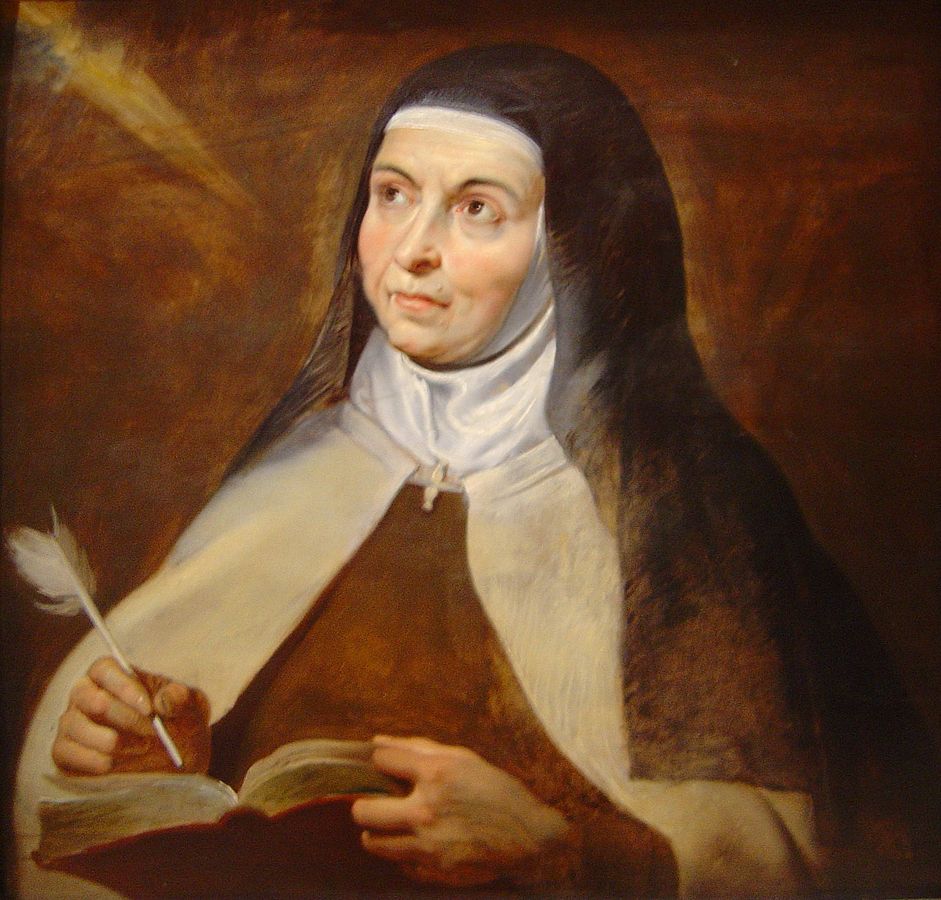
Teresa Sanchez of Avila, born in 1561, learned to read by reading the lives of the saints. When she was seven, therefore, she talked her little brother, Rodrigo, into running off to Africa with her to be martyred by the Muslims. Fortunately, the runaways encountered their uncle, who promptly brought them back home. So Teresa was a saint already at seven? Not at all. Just a good girl with a lively imagination. At the age of 20 she ran away again, this time to join the Carmelites in their nearby monastery. Her aristocratic father had opposed that idea thus far, but now he consented. So Teresa was a saint by 20? Not at all, First came three years of illness. Then, when her body recovered, she began to take care of her soul. With proper spiritual guidance she reached those heights of prayer that you and I can never really understand because God has chosen not to raise us to that level. Only when she had been 25 years a nun did St. Teresa’s task as a reformer begin. Having first reformed herself, she was now ready to help others to become holier.
One of the reasons why the Protestant Reformation had made such headway was that many members of Catholic religious orders had been setting bad example rather than good example. So Catholic reformers now had to jack up, first of all, the ideals and practice of men and women religious. Teresa began by establishing a stricter life in her own Carmelite monastery in Avila. After that, she set up, all in all, about a dozen convents in which poverty was really poverty and prayer was really prayer. No half-measures. She also established two reformed monasteries of Carmelite men, and then let the Spanish Carmelite mystic, St. John of the Cross, take over the men’s reform from there. This more austere branch of the Carmelites, men and women alike, was called the “Discalced Carmelites” because the members wore open sandals rather than shoes.
A brief sketch of St. Teresa of Avila like the above can only hint at her greatness, for great she was. She was so great as a spiritual writer that in 1970 Pope Paul VI proclaimed her a “doctor of the Church” - the first woman ever given that title. She was a great reformer. What she did for the Carmelites had much wider repercussions. It set an example for other religious orders, and the spiritual revival of all these orders quickly percolated down to the Catholic faithful whom they served, and to the Church in general. She was a great person.
Do you picture her as a languishing neurotic? She was anything but! Teresa was plump, pleasant, forthright and had a delightful common sense of humor. A few stories will illustrate. One night when Teresa was sleeping in the same room as another nun, the nun said, “I was just wondering. If I should die now, what would you do alone with a corpse?” Teresa, though a bit startled, answered, “I will think about that when it happens, sister. Now, let’s go to sleep.” When she was about to found a monastery at Toledo she discovered she had no cash but five ducats. Somebody asked how she could open a convent with such small funds. “Teresa and five ducats are nothing”, she replied; “but God, Teresa and five ducats, that’s everything!” In accepting candidates for her order, she looked for intelligence first, piety second, she said; but “God preserve us from stupid nuns!” These three are true stories. Perhaps the last one is just a legend, but it is still typical. One day, they say, Teresa was riding a donkey from one of her convents to another. When they came to a big mud-puddle, the sassy donkey balked and threw the saint right into the muck. St. Teresa, always in touch with God, said, “Lord, why this?” He answered, “That is the way I treat my friends.” Teresa came back, “Then no wonder You have so few!” St. Teresa, help us not to take ourselves too seriously. --Father Robert F. McNamara
Scripture.Rom 8:22-27
Brothers and sisters: We know that all creation is groaning in labor pains even until now; and not only that, but we ourselves, who have the firstfruits of the Spirit, we also groan within ourselves as we wait for adoption, the redemption of our bodies. For in hope we were saved. Now hope that sees for itself is not hope. For who hopes for what one sees? But if we hope for what we do not see, we wait with endurance. In the same way, the Spirit too comes to the aid of our weakness; for we do not know how to pray as we ought, but the Spirit himself intercedes with inexpressible groanings. And the one who searches hearts knows what is the intention of the Spirit, because he intercedes for the holy ones according to God’s will.
Writings
(Year A). O King of glory and Lord of all kings! Thy kingdom is not fenced in by trifles, but is infinite. No third party is required to obtain us an audience of Thee. We have only to look at Thy person to see at once that Thou alone deservest to be called Lord. Thou revealest Thy majesty; we need no sight of a retinue or guard to convince us that Thou art a King. An earthly king can scarcely be recognized as such in his own person; for, however much he may wish to be so recognized, no one will believe he is a king if there is nothing about him to distinguish him from others; his majesty must be seen to be believed. So it is reasonable that kings should maintain this artificial authority, for, if they had none, nobody would respect them, as their appearance of power does not come from themselves and their authority must of necessity come from others. O my Lord! O my King! If one could but picture Thy majesty! It is impossible not to see that in Thyself Thou art a great Emperor, for to behold Thy majesty strikes terror. But my terror is greater, my Lord, when together with Thy majesty I behold Thy humility and the love that Thou bestowest on such a creature as I. We can converse and speak with Thee about anything, just as we wish, when we have lost our initial fear and terror at seeing Thy majesty and acquired a deeper fear of offending Thee -- but not a fear of punishment, my Lord, for that is of no account by comparison with loss of Thee! Here, then, are the benefits of this vision, setting aside other important ones which it leaves behind in the soul. If the vision is of God, its source will be recognizable by its effects, when the soul receives light — for, as I have often said, the Lord may be pleased for the soul to be in darkness and not to see this light, so it is not surprising if one who knows herself to be as wicked as I should be afraid. (Autobiography)
Musical Selection
Christ has no body now but yours
No hands, no feet on earth, but yours
Yours are the eyes through which He looks
Compassion on this world
Yours are the feet with which He walks
To do good
Yours are the hands
With which He blesses all the world
Yours are the hands
Yours are the feet
Yours are the eyes
You are His body
Christ has no body now but yours
No hands, no feet on earth, but yours
Yours are the eyes through which He looks
Compassion on this world
Christ has no body now on earth
But yours
Collect
Merciful God, who by our Spirit raised up your servant Teresa of Avila to reveal to your Church the way of perfection: grant that her teaching may awaken in us a longing for holiness, until we attain to the perfect union of love in Jesus Christ our Son our Lord, who lives and reigns with you, in the unity of the Holy Spirit, one God, now and for ever. Amen.(English Missal)