June 12
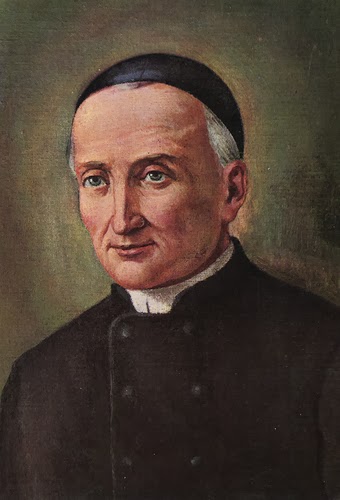
St. Gaspar Bertoni
Life
GASPAR BERTONI was born in Verona, in the Republic of Venice, on October 9, 1777, of Francis Bertoni and Brunora Ravelli of Sirmione. He was baptized the following day by his grand-uncle, Fr. James Bertoni, in the parish church of St. Paul, in the Campo Marzo section of Verona. On both sides of the family, the profession of "Notary" was exercised, and from an old legal document, it can be seen that the family was fairly well off. Even more outstanding, however, was the practice of the faith. Following the death of his baby sister, young Gaspar remained the only child. He had the benefit of an excellent education both at home and at St. Sebastian's school, that was conducted by the municipality after the suppression of the Jesuits. They, however, continued teaching and also in the direction of the Marian Congregation. Young Bertoni here came under the influence of Fr. Louis Fortis, who would in the future be the first Jesuit General after the reinstatement of the Company of Jesus. From the grace of his first Holy Communion at age 11, Gaspar Bertoni was called to a life of mystical union. His vocation to the priesthood matured, and at 18, he entered the seminary. In frequenting the theological course as an extern student, he found in his professor of moral theology, Fr. Nicholas Galvani, an excellent spiritual director.
During his first year of theology, he witnessed the invasion of the French armies (June 1, 1796). This was the beginning of a 20 year period of great upheaval for his native city. Inspired by deep charity, he dedicated himself to the assistance of the sick and wounded, as a member of a Gospel Fraternity for the Hospitals, that had just then been instituted by the Servant of God, Fr. Peter Leonardi. At his priestly ordination (September 20, 1800), at the dawn of a new century, he found himself in a world in need of much assistance for the resolution of the serious problems that disturbed it. His pastor assigned the youth of parish to his pastoral care. He dedicated himself with all his energies and great organizational ability to the new mission. He established an Oratory in the form of a "Marian Cohort", that had as its goal the Christian and social formation of the youth. All such organizations were suppressed by a decree from Napoleon (1807), and Fr. Bertoni reserved the carrying out of his plans for better times.
Meanwhile, he took over the spiritual direction of a community founded then by St. Magdalena of Canossa at St. Joseph's Convent (May 1808). It was here that he met the Servant of God, Leopoldina Naudet, whom he would then spiritually guide to the heights of the mysticism of holy abandonment and to the foundation of the Sisters of the Holy Family. He extended this aspect of his ministry to another Servant of God, Teodora Campostrini, of a noble family, both in the discernment of her vocation, as in the foundation of her Community, of the "Sorelle Minime" of the Charity of the Sorrowful Mother.
By September of 1810, he had already moved from his family home after the death of his mother, and was transferred from St. Paul's Parish, to St. Firmus Major. Here, the bishop also entrusted him with the spiritual direction of the seminarians in the diocesan seminary. A solid spiritual and theological formation of the young was always the clear objective of the frequent gatherings that he held in his own home. At this time, he began to organize this endeavor in a more orderly fashion. His overall idea was the renewal of the clergy based on an unconditional adherence to the Supreme Pontiff, Pius VII, at that time, Napoleon's prisoner. For Fr. Bertoni, the Pontiff, was always "the first and irremovable stone" of the Church. The reform of the Church had to begin from the sanctuary itself, with the return of its ministers to the integral following of the Gospel. The diocesan seminary was going through a very bad crisis. However, in a short time it regained its proper form, and even assumed a monastic aspect as a contemporary witness stated.
With the fall of Napoleon, the need for restoration was widely felt. Fr. Bertoni clearly understood that to gather the flock once again, it would be necessary to awaken them by the presentation of the fundamental truths of the faith through the preaching of missions to the people. On December 20, 1817, Pope Pius VII conferred on him a precise mandate, by conferring on him the faculty of "apostolic missionary". While the suspicious government of Austria forbade this specific ministry, Fr. Bertoni dedicated himself to other preaching and catechetical instruction. While becoming all things to gain all for Christ, Fr. Bertoni cultivated a very intense interior life. From the reading of his Spiritual Diary, it appears that he was also grace by mystical gifts. Among these, was the call, made evident to him by grace, to the foundation of a religious family.
On November 4, 1816, with two companions, he moved into a small house, adjacent to a suppressed Church, that bore the title of "the Sacred Stigmata of St. Francis (from this, the name of his community was eventually adapted; in this small church, he also worked to spread the devotion to the Passion and the wounds of Christ). In a very unostentatious manner, the new community opened a tuition-free school, offering this and other gratuitous services to the Church and society. The men lived together a common life of strict observance and penance. An intense life of contemplation was joined to a broad apostolate, including the Christian education of the youth, the formation of the clergy and missionary preaching, in perfect availability to the requests of the bishop.
Right after an ecstasy that he experienced praying before a Crucifix (on May 30, 1812), he suffered a first attack of "miliary fever" that brought him to the very threshold of death. Almost miraculously, he did recover but for the rest of his 41 years of life he remained in poor health, all this while giving a wonderful example of patience and heroic confident abandonment to God.
Even from his sick-bed, suffering indescribable discomfort, he became the "angel of counsel" for countless persons who sought him out. A number among these were gifted human beings, who were founding charitable works, such as Blessed Charles Steeb, the Servants of God, Fr. Nicholas Mazza and Fr. Anthony Provolo - and others from outside the city, who came to Verona to meet with him.
An authentic image of Christ Crucified, with his nearly 300 surgical procedures on his right leg that he endured, he could not suffer enough for the good of the Church and the salvation of souls. Once his infirmarian asked him if he needed anything - and among his last words were: "I need to suffer". In a vision of vivid hope in the Risen Christ, bearing the signs of His Triumph, and supported by the Holy Spouses and Patrons, Mary and Joseph, he died a holy death, at 3:30 on a Sunday afternoon, June 12, 1853. His Congregation of the Sacred Stigmata of Our Lord Jesus Christ, enriched by so many sufferings, gradually spread beyond Verona, to other cities in Italy, and then to the United States, to Brazil (where it presently has 6 Bishops), to Chile, to the Philippines and to mission territories: South Africa, the Ivory Coast, Tanzania, Thailand.
Source: https://www.vatican.va/news_services/liturgy/saints/ns_lit_doc_19891101_bertoni_en.html
Scripture (1 Pet 2:21b-25)
Christ suffered for you, leaving you an example, that you should follow in his steps. “He committed no sin, and no deceit was found in his mouth.” When they hurled their insults at him, he did not retaliate; when he suffered, he made no threats. Instead, he entrusted himself to him who judges justly. “He himself bore our sins” in his body on the cross, so that we might die to sins and live for righteousness; “by his wounds you have been healed.” For “you were like sheep going astray,” but now you have returned to the Shepherd and Overseer of your souls.
Writings
(Year A). Jesus has died, and is there no one who is moved? So, the Just Man perishes in a sea, drowning in sufferings, and is there no one to weep? I have to say it again, and no one lays it to heart. And so, what is being said here: there is no one who is moved? It would be necessary to be on that mountain a few minutes earlier, when in all His anguish of dying, as He was just about to give up His last breath. One could note however, nature itself responded out of pity for Him: the sun hid its face, the rocks were rent, the earth trembled on its axis. Would I, therefore, see before me only these, my listeners, with tranquil faces, serenely looking on? Why is it these faces are not reddened with weeping? How is it that these hearts are not broken? Why is it that the by-standers are not profoundly moved? And these women, who weep so bitterly over the deaths of their own children, their husbands, their lovers - and these men who are so deeply upset by their own reverses, as well as of those of their fellow-citizens - they do not shed a single tear, nor do they have a simple sigh left for Jesus? Is it that only Jesus is not mourned, He is not wept over? Just listen to His own complaint regarding you: ...And I looked for one that would grieve together with me, but there was none... [Is 68:21]. Why is it, my brothers and sisters, that there are such coldness, such ingratitude, and even injustice, and that those tears of compassion that you shed so prodigiously at the sufferings of just any poor soul, you so cruelly deny Jesus? Have you perhaps had a change of heart on this very point that the underlying motives - that are even stronger - that Jesus offers you for having compassion in His regard, to not move you? Or, is it that you just do not know these motives? Do you not realize that He has suffered? But, you do know through faith that He had to languish on a cross. Do you understand that He suffered all of this for you? Faith, though, teaches you that “... for us men and for our salvation...” He did this for us. How can it be, therefore, that you are not deeply moved, believing all this? Should we conclude, then, that there is either lacking faith, and that your faith has grown so languid? It cannot be this, my listeners. May heaven keep me from drawing any such conclusion so insulting to your piety What, then, is the origin of such insensibility of heart? The Holy Spirit responds for us: ... The just perishes, and no man lays it to heart... [Is 57:1]. He is just not considered, and this is why no compassion is given. This is the real reason, while the Philosopher also teaches on the other hand that to bring something within the sphere of compassion so that this will excite compassion in others, it is necessary that it be brought close. Thus, we observe that the miseries of others far from us, either distant in space, or in the passing of time, either do not touch our hearts, or do so only in a very slight manner. For this reason, all I have to do is expose these facts, with all simplicity, as they unfolded. My task, then, is to render Jesus’ Passion close, not only to your thought, but to your very eyes. In this way, the reality of it which is of all events. the most able to draw a compassionate response, will indeed become the object of your most actual and most tender compassion. However, before going on in drawing out for you this sorrowful narrative, there is suddenly before me that warm Cross, that is still marked with the blood of this Just Man. I now place this before your eyes, prior to any other reality. to test the impression that such a sight is able to make on your hearts. Holy Cross, that I should now adore as that which alone was worthy to bear that August Victim sacrificed on you for our sins - I know only too well the many and varied affections that you can arouse in the hearts of these listeners. You have now become the standard of their faith, the sure guide of their lives, the foundation of their hope, comfort in their wretchedness, the desire of the just, the terror of hell. But, I ask you that the sight of you arouse today only a sadness and a dolor that will be most vibrant for those terrible sufferings that you brought to our Jesus, when He united Himself to you out of love for us. Show, therefore, to these souls who devoutly gaze upon you those cruel clefts of those nails made in you, first lacerating His hands, and then His feet. Show the very place where His head reclined upon you, expiring, as their loving Father, indeed their faithful Friend, their most tender Brother, their most lovable and most kind Spouse. Lastly, show that bloodshed out of love for them, with which you still trickle and redden in long streams. In addition to the impression that you can bring about in them, let there be joined also the eloquence of this blood, as the Apostle describes [Heb 12:24]. Let there be attained, therefore, through you such a great commotion in the hearts of these listeners that I believe I will see this very day, even though I cannot achieve this with my words. (Good Friday Sermon on the Passion)
Musical Selection
Collect