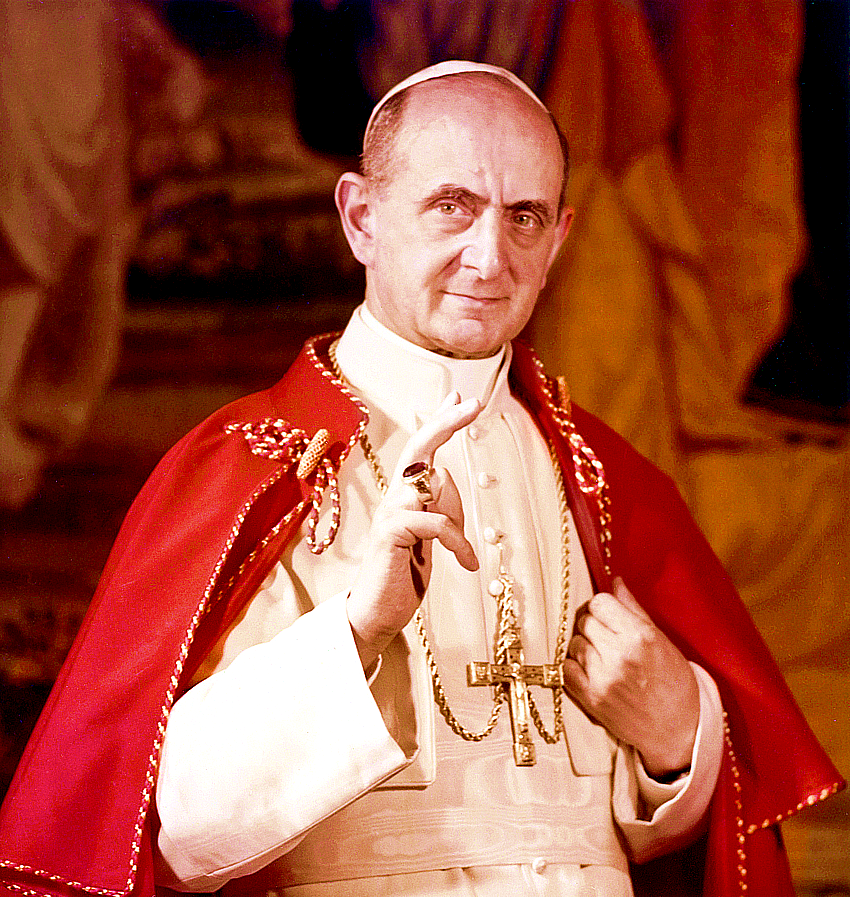
Born near Brescia in northern Italy, Giovanni Battista Montini was the second of three sons. His father, Giorgio, was a lawyer, editor, and eventually a member of the Italian Chamber of Deputies. His mother, Giuditta, was very involved in Catholic Action.
After ordination in 1920, Giovanni did graduate studies in literature, philosophy, and canon law in Rome before he joined the Vatican Secretariat of State in 1924, where he worked for 30 years. He was also chaplain to the Federation of Italian Catholic University Students, where he met and became a very good friend of Aldo Moro, who eventually became prime minister. Moro was kidnapped by the Red Brigade in March 1978, and murdered two months later. A devastated Pope Paul VI presided at his funeral.
In 1954, Fr. Montini was named archbishop of Milan, where he sought to win disaffected workers back to the Catholic Church. He called himself the “archbishop of the workers” and visited factories regularly while overseeing the rebuilding of a local Church tremendously disrupted by World War II.
In 1958, Montini was the first of 23 cardinals named by Pope John XXIII, two months after the latter’s election as pope. Cardinal Montini helped in preparing Vatican II and participated enthusiastically in its first sessions. When he was elected pope in June 1963, he immediately decided to continue that Council, which had another three sessions before its conclusion on December 8, 1965. The day before Vatican II concluded, Paul VI and Patriarch Athenagoras revoked the excommunications that their predecessors had made in 1054. The pope worked very hard to ensure that bishops would approve the Council’s 16 documents by overwhelming majorities.
Saint Paul VI had stunned the world by visiting the Holy Land in January 1964, and meeting Athenagoras, the Ecumenical Patriarch of Constantinople in person. The pope made eight more international trips, including one in 1965, to visit New York City and speak on behalf of peace before the United Nations General Assembly. He also visited India (1964), Colombia (1968), Uganda (1969), and seven Asian countries during a 10-day tour in 1970.
Also in 1965, he instituted the World Synod of Bishops, and the next year decreed that bishops must offer their resignations on reaching age 75. In 1970, he decided that cardinals over 80 would no longer vote in papal conclaves or head the Holy See’s major offices. He had increased the number of cardinals significantly, giving many countries their first cardinal. Eventually establishing diplomatic relations between the Holy See and 40 countries, he also instituted a permanent observer mission at the United Nations in 1964. Paul VI wrote seven encyclicals; his last one in 1968 on human life—Humanae Vitae—prohibited artificial birth control.
Saint Paul VI died at Castel Gandolfo on August 6, 1978, and was buried in St. Peter’s Basilica. He was beatified on October 19, 2014, and canonized on October 14, 2018. Since 2019 his liturgical feast has been celebrated on May 29.
If I preach the Gospel, this is no reason for me to boast,
for an obligation has been imposed on me,
and woe to me if I do not preach it!
If I do so willingly, I have a recompense,
but if unwillingly, then I have been entrusted with a stewardship.
What then is my recompense?
That, when I preach,
I offer the Gospel free of charge
so as not to make full use of my right in the Gospel.
Although I am free in regard to all,
I have made myself a slave to all
so as to win over as many as possible.
To the weak I became weak, to win over the weak.
I have become all things to all, to save at least some.
All this I do for the sake of the Gospel,
so that I too may have a share in it.
Writings
(Year A). Our intense desire is to see the Church become what Christ intended it to be: one, holy, and entirely dedicated to the pursuit of that perfection to which Christ called it and for which He qualified it. In its pilgrimage through the world the Church must really strive to manifest that ideal of perfection envisaged for it by the divine Redeemer. Here, therefore, we have the greatest problem confronting the living Church. It is a problem which shows how powerful and effective the Church really is. It goads it into action, submits it to searching criticism and keeps it true to its purpose. It engenders in the Church prayer and compunction, repentance and hope, toil and confidence, the spirit of adventure and achievement. It is a problem which arises from the very nature of the truths revealed by God and their special relevance to our lives as human beings. For without reference to Christ's teaching handed on by the Church, it is not possible for man to pass judgment on himself and his own nature, his former state of perfection and the ruinous consequences of original sin, his capacity for good and his need for help in desiring and achieving what is good, the importance and purpose of this present life, the good that he seeks or already possesses, how best to acquire perfection and holiness, and how to attain to the highest degree of perfection and completeness. Hence the Church must be gripped with an intense and unfailing desire to learn the ways of the Lord. It is Our dearest wish that all those valuable discussions concerning Christian perfection which have gone on for so many centuries in the Church, shall once again receive the importance they deserve and arouse the faithful, not indeed to formulate new rules of spirituality, but to generate new energies in striving after the holiness which Christ has taught us. His own words and example, his guidance and assistance, have made it possible for us to know about this holiness and to desire it and achieve it. This method of spirituality which is confirmed by the custom and tradition of the Church, established by the united action of its members, and exemplified in the outstanding lives of the Saints. The very external conditions in which the Church finds itself give added impetus to this striving for religious and moral perfection, for the Church cannot remain indifferent to or unaffected by the changes which take place in the world around. They influence, modify, and condition its course of action in all sorts of ways. As we know, the Church does not exist in isolation from the world. It lives in the world, and its members are consequently influenced and guided by the world. They imbibe its culture, are subject to its laws and adopt its customs. This intimate contact with the world is continually creating problems for the Church and at the present time these problems are extremely acute. The Christian life, as encouraged and preserved by the Church, must resist every possible source of deception, contamination, or restriction of its freedom. It must guard against these things as it would guard against contamination by error or evil. Yet at the same time it must not only adapt itself to the forms of thought and living which a temporal environment induces, one might almost say imposes, on it-provided, of course, such forms are not incompatible with the basic principles of its religious and moral teaching-but it must also strive to approach these forms and to correct, ennoble, encourage, and sanctify them. And this demands of the Church a continual process of self-examination and re-appraisal of its external conduct. This in fact is what the present era is demanding of the Church with such insistence and earnestness. (Ecclesiam suam)
Musical Selection(Palestrina)
Tu es Petrus
Et super hanc petram aedificabo ecclesiam meam
Et portae inferi non praevalebunt adversus eam.
Et tibi dabo claves regni caelorum.
You are Peter,
And upon this Rock I will build My Church:
and the gates of hell shall not overcome it.
And I will give you the keys to the kingdom of heaven.
Collect
O God, who entrusted the governance of your Church to Pope Saint Paul the Sixth, a steadfast apostle of the Gospel of your Son, grant, we pray, that enlightened by his teachings, we may work together with you to spread the culture of love throughout the world. Through our Lord Jesus Christ, your Son, who lives and reigns with you in the unity of the Holy Spirit, God, for ever and ever. Amen.